
The AI Act now applies in full. Does your organisation?
Since 2 August 2026 the transition period of the EU AI Act is over. The obligation to ensure AI literacy (article 4) has applied since February 2025 to every organisation that uses AI, which includes municipalities, agencies and other public institutions. Regulators have been appointed and they ask you to show your work. A purchased e-learning is not evidence. I help public organisations turn the obligation into a learning system that holds up in practice.
Article 4 in force
2 Feb 2025
Fixed price scan
€ 4,950
Lead time
2 to 3 weeks
of AI efforts with no measurable effect
95%
Four dates that set the agenda
2 February 2025
Article 4 in force: demonstrable AI literacy is mandatory for staff who work with AI. The prohibited AI practices apply from this date as well.
2 August 2025
Governance and penalty provisions in force. Fines run up to 35 million euro or 7 percent of turnover.
2 August 2026
The Act applies in full, including the obligations for high-risk AI systems. This date has passed.
2 August 2027
Final transition deadline, only for AI embedded in already regulated products.
The question is no longer whether you have to act, but whether you can show what you have done.
Three demands a course does not satisfy
Literacy that fits the role
Not everyone needs to know the same things. A front-desk officer using an AI assistant needs different knowledge than a policy adviser who procures algorithmic systems. The law asks for learning built per role, not one course for everyone.
Literacy that fits the context
For public bodies this weighs heavier: decisions affect citizens directly. Literacy here also means knowing when AI is not the right instrument, and being able to say so.
Literacy you can demonstrate
When the regulator, the council or the works council asks, you need to show what people learned and how it sits in the work. Attendance lists from an e-learning are not capability.
What municipalities ask about article 4
Who does the AI literacy obligation apply to?
To every organisation that uses or provides AI systems, which includes municipalities, agencies, water boards and other public institutions. Article 4 asks that staff who work with AI, or decide on its use, are sufficiently literate for their role. The obligation has applied since 2 February 2025.
What counts as AI literacy?
Knowledge and skills that fit the role and the context: knowing what a system does, where it fails, which risks it carries for citizens, and when AI is not the right instrument. A front-desk officer with an AI assistant needs different knowledge than a policy adviser who procures algorithmic systems.
Is one e-learning for all staff enough?
No. An attendance list shows who took a course, not what people can do and how it sits in the work. The regulation asks for literacy that fits the role and can be demonstrated in practice. That is why this offer starts with a scan per role group and ends with coaching on the job and a re-measurement.
How do I demonstrate AI literacy to the regulator or the council?
With a recorded picture of the AI use, guidelines per role, a learning path that matches that use, and a measurement of what staff can do. The scan report is exactly that document: readable for the board, the council and the regulator, with a follow-up plan attached.
What does it cost and how long does it take?
The AI literacy scan has a fixed price of EUR 4,950 and delivers a complete picture and a follow-up plan in two to three weeks. The implementation programme starts at EUR 15,000. Interim implementation and adoption management is agreed case by case.
Do I need to run a tender?
The scan falls under most thresholds for a single-source award. The implementation programme and interim roles run through your own procurement rules or through staffing desks. Check with your procurement adviser; we go through it in the first conversation.
From obligation to working practice
AI literacy scan
In two to three weeks you get the full picture: where your organisation stands against article 4, which AI use is already happening (including the use you cannot see), and a tier classification of what can continue, what cannot, and what can under conditions. You get a report that your board, council and regulator can read, plus a concrete learning plan for the twelve months after. Fixed price and fixed scope, so it fits a single purchase decision.
Implementation programme
Learning tracks per role rather than one course for everyone, guidelines people can actually follow, a network of internal champions who coach colleagues in the flow of work, and a re-measurement after six months. Built on the VERIFY method, developed for organisations that carry public trust.
Interim implementation and adoption management
A temporary role inside your organisation to move AI literacy and adoption from policy to practice. Available directly and through public-sector contracting desks.
The 5 percent that works does something different
Research by MIT and Microsoft (2025 and 2026) shows that 95 percent of AI implementations produce no measurable effect. The 5 percent that does work has one thing in common: AI is embedded in how the work is organised. Workflows redesigned, standards written down, internal coaches active, leadership visibly taking part. That layer sits on top of literacy, and it is exactly what my VERIFY method is built on. Training alone never gets you there; learning has to be attached to the work people already do.
01
Diagnose
Measure what is actually happening: which AI is in use, what people can do per role, and where the risks sit.
02
Design
Guidelines, role profiles and learning tracks that fit the work, written down so you can show them.
03
Embed
Internal champions, coaching in the flow of work and a re-measurement after six months, so it does not stop at a training day.
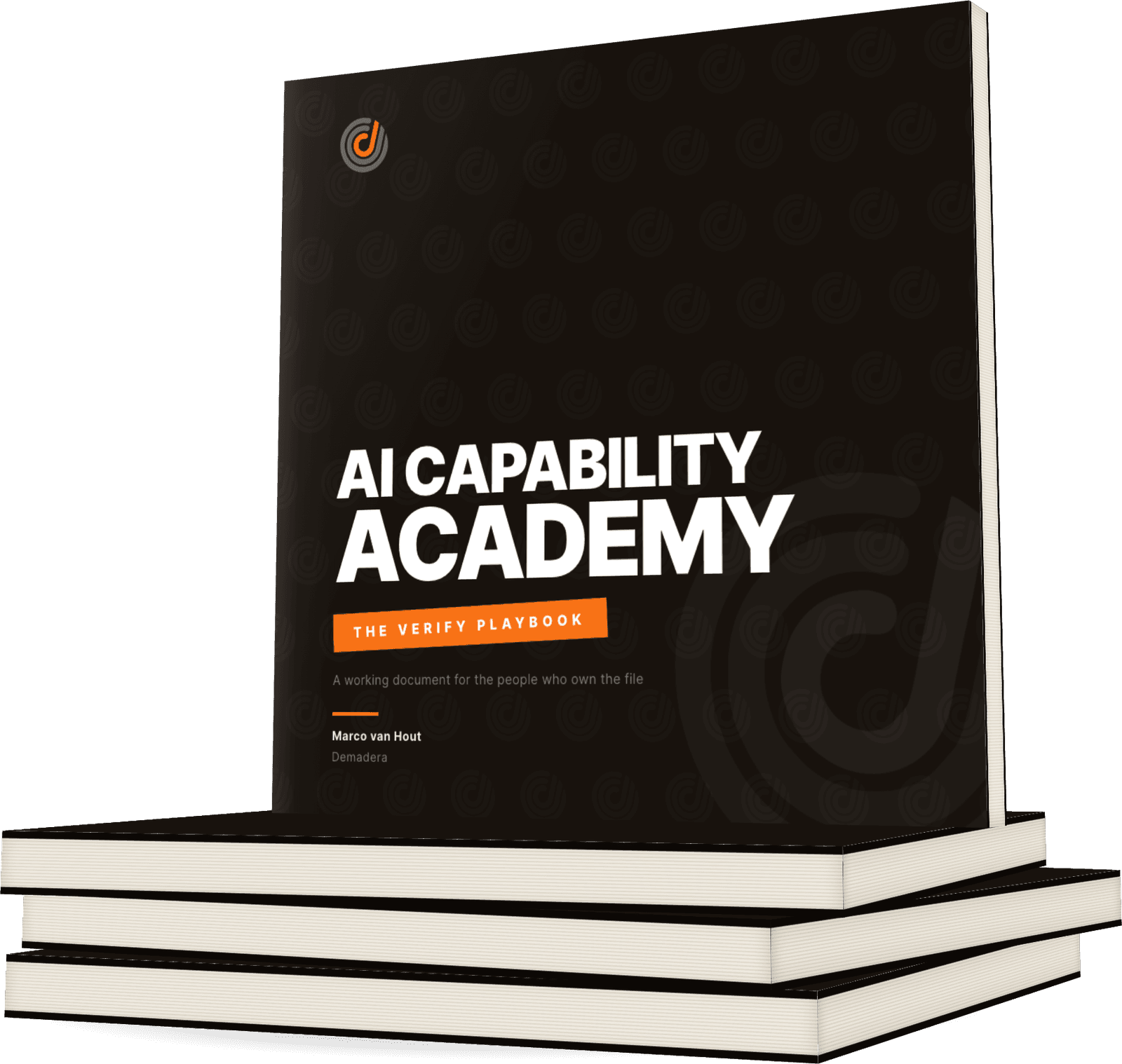
VERIFY
VERIFY is the method behind the scan and the implementation programme: six steps to move AI from scattered pilots to work that is written down and taught. The reader explains in short what those steps look like inside a public organisation. The printed playbook, the working document your people fill in themselves, comes with an engagement.
- Six steps, from proving value to embedding it
- Written for organisations that carry public trust
- The printed playbook comes with an engagement
Who does this
Marco van Hout has been building learning and change programmes for 25 years. He co-founded the Digital Society School at Amsterdam University of Applied Sciences, leads the Global Goals Jam network with UNDP across 95+ cities, and since 2025 works full time on AI capability for governments and regulated organisations, including a national AI programme for a government body in the Gulf region and a pharmaceutical multinational. He founded the AI Capability Academy and wrote the VERIFY Playbook.

Marco van Hout
Demadera Capability & Transformation Design
Digital Society School
Co-founder at Amsterdam University of Applied Sciences
Global Goals Jam
Leads the UNDP network across 95+ cities
VERIFY Playbook
Author, and founder of the AI Capability Academy
An initiative of Demadera Capability & Transformation Design · sister programme of aicapability.academy
Want to know where you stand?
Request the AI literacy scan or book a 30 minute call, no strings attached.
- You get a reply within one working day.
- The intro call takes 30 minutes and costs nothing.
- After that you get a proposal with scope, timeline and price.
Prefer to reach me directly? demadera@marcovanhout.com